How an environmental document management system helps industries manage compliance documents, audit files, licences and regulatory records securely.
Environmental compliance generates hundreds of documents throughout the lifecycle of an industrial facility. These include permits, approvals, monitoring reports, audit reports, waste manifests, inspection records, and regulatory submissions.
Managing these records using paper files or scattered folders can make it difficult to locate documents during inspections or renewals.
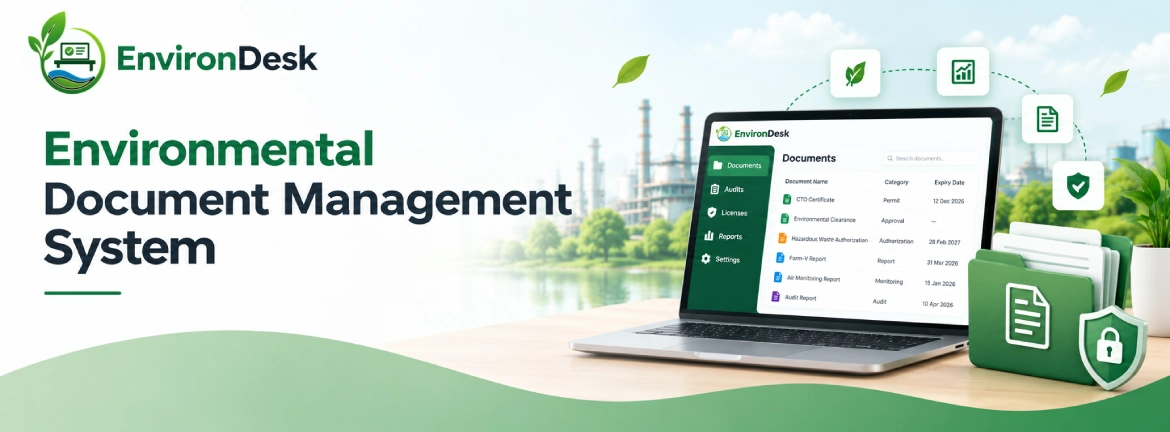
An Environmental Document Management System (EDMS) is a centralized digital platform that securely stores, organizes, tracks, and retrieves environmental compliance documents. It helps organizations maintain complete, accurate, and easily accessible records while supporting regulatory compliance and audit readiness. Modern document management systems improve efficiency, strengthen document control, and reduce the risk of using outdated versions.
Why Environmental Document Management Matters
Industrial organizations must maintain environmental documentation throughout the validity of their approvals and operations.
Typical records include:
- Consent to Establish (CTE)
- Consent to Operate (CTO)
- Environmental Clearance (EC)
- Hazardous Waste Authorizations
- Laboratory analysis reports
- Air emission reports
- Water quality reports
- Waste disposal records
- Inspection reports
- Internal audit reports
- Form-V Annual Environmental Statements
Without a structured system, organizations risk losing records, delaying audits, or missing critical renewal requirements.
1. Compliance Documents
Environmental regulations require businesses to maintain complete compliance documentation.
An Environmental Document Management System helps organize:
- Environmental permits
- Consent certificates
- Regulatory approvals
- Compliance calendars
- Monitoring records
- Legal registers
- Environmental correspondence
Instead of storing files across multiple folders or computers, every compliance document is available from one secure location.
This complements EnvironDesk's GPCB Compliance Checklist, where maintaining updated compliance documentation is essential for ongoing regulatory compliance.
2. Audit Files
Environmental audits require quick access to historical records and supporting evidence.
An Environmental Document Management System enables organizations to maintain:
- Internal audit reports
- External audit reports
- Inspection checklists
- Corrective action records
- Photographic evidence
- Supporting compliance documents
Auditors can retrieve information quickly without searching through paper files or multiple folders.
Maintaining organized audit records supports smoother regulatory inspections and internal reviews.
3. Licenses & Regulatory Approvals
Industrial facilities must maintain multiple environmental licenses and approvals throughout their operations.
These commonly include:
- Consent to Establish (CTE)
- Consent to Operate (CTO)
- Environmental Clearance
- Hazardous Waste Authorization
- EPR Registrations
- Other statutory environmental approvals
An Environmental Document Management System stores these approvals digitally while tracking expiry dates, renewals, and supporting documentation.
4. Environmental Reports
Environmental reporting is an ongoing compliance requirement for many industries.
Organizations regularly prepare:
- Form-V Annual Environmental Statement
- Air monitoring reports
- Water monitoring reports
- Hazardous Waste Returns
- Environmental monitoring summaries
- Management reports
An Environmental Document Management System ensures reports are securely stored, searchable, and linked to supporting monitoring records.
This aligns with the documentation practices described in EnvironDesk's Form-V Annual Environmental Statement guide.
5. Secure Document Storage
Environmental documents often contain sensitive regulatory information that must be protected.
A modern Environmental Document Management System provides:
- Centralized cloud storage
- Role-based user access
- Document version control
- Searchable document repository
- Backup and recovery
- Secure document sharing
These capabilities help organizations reduce the risk of document loss while ensuring employees always access the latest approved version. Secure document repositories with version control and lifecycle management are considered best practice in regulated industries.
Key Benefits of an Environmental Document Management System
- Centralized compliance document storage
- Faster audit preparation
- Better license management
- Improved environmental reporting
- Secure document access
- Reduced paperwork
- Better compliance visibility
- Improved collaboration
- Faster document retrieval
- Stronger regulatory readiness
How EnvironDesk Helps
EnvironDesk provides a centralized platform for managing environmental compliance documents throughout their lifecycle.
With EnvironDesk, organizations can:
- Store compliance documents securely
- Manage environmental licenses and approvals
- Organize audit files
- Maintain monitoring reports
- Track document expiry dates
- Retrieve records instantly during inspections
- Improve collaboration through role-based access
Whether managing one facility or multiple manufacturing sites, EnvironDesk helps businesses simplify document management while improving compliance efficiency. Explore EnvironDesk's features or see how it serves your industry sector.
Frequently Asked Questions
What is an Environmental Document Management System?
An Environmental Document Management System is software that helps organizations securely store, organize, retrieve, and manage environmental compliance documents from one centralized platform.
What documents should be stored in an EDMS?
Common documents include CTE, CTO, Environmental Clearance, hazardous waste authorizations, monitoring reports, audit files, inspection reports, and Form-V submissions.
Why is secure document storage important?
Secure storage protects compliance records, improves version control, prevents data loss, and enables faster access during inspections and audits.
Which industries benefit from an Environmental Document Management System?
Industries such as chemical, pharmaceutical, textile, engineering, food processing, plastic, paper, steel, cement, automotive, and power generation can all benefit from a centralized environmental document management solution.
Get the free GPCB compliance checklist
Every clearance a Gujarat factory needs, with document lists and renewal timelines. 12 pages, no charge.
Vishal Mevada
Co-founder, EnvironDesk
Vishal spent nine years running environmental compliance for factory clients across Gujarat's GIDC estates before starting EnvironDesk. He has filed more CTO renewals than he cares to count.
General information, not legal advice. Environmental regulation changes, and how a rule applies depends on your unit's category, location and consent conditions. Verify anything decision-critical against the current GPCB or CPCB position, or take professional advice.
Related reading
All articles → Guide5 min read
What is Environmental Management Software? A Complete Guide to Compliance, Monitoring, Reporting & Audits
Learn what Environmental Management Software is, its key features, benefits, and how it helps businesses manage compliance, monitoring, reporting, and audits.
Read more Guide6 min read
Benefits of Environmental Management Software: Why Every Indian Industry Should Go Digital
The key benefits of environmental management software: automated compliance tracking, centralised documents, faster audits, better reporting, less risk.
Read more