
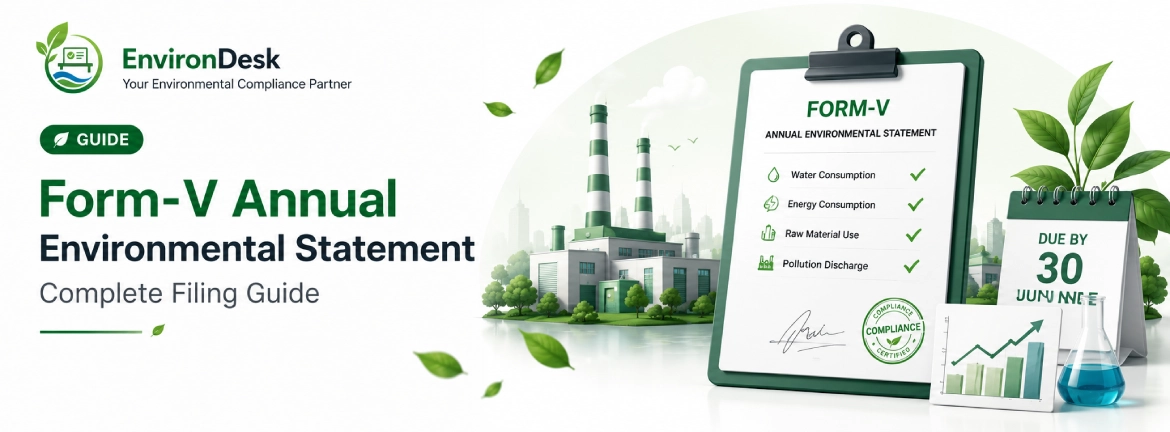
Who must file Form-V, the 30 September deadline, every part of the form explained, the data you need to gather, and the mistakes that trigger GPCB queries.
Form-V is the annual environmental statement every consented unit in India owes its State Pollution Control Board. It is filed once a year, it summarises what your factory consumed and discharged, and it is one of the very few documents where you tell the regulator, in your own numbers, how you actually performed.
It is also routinely filed badly — late, incomplete, or with figures that contradict the unit's own monitoring reports. This guide covers who files, when, what goes in each part, and where it goes wrong.
Who has to file Form-V
The obligation comes from Rule 14 of the Environment (Protection) Rules, 1986. It applies to every operator of an industry, operation or process that requires consent under the Water Act, 1974 or the Air Act, 1981, or authorisation under the Hazardous Waste Rules.
In practice: if you hold a CTO, you file Form-V. There is no small-unit exemption, no Green-category exemption, and no 'we had a quiet year' exemption. A unit that operated for one month of the financial year still files.
The deadline: 30 September
Form-V covers the financial year ending 31 March and is due on or before 30 September of the same calendar year. That gives you six months, which sounds generous and is exactly why the form gets filed on 29 September.
| Period covered | Due by | Practical start date |
|---|---|---|
| 1 Apr 2025 – 31 Mar 2026 | 30 Sep 2026 | Early August 2026 |
| 1 Apr 2026 – 31 Mar 2027 | 30 Sep 2027 | Early August 2027 |
What's in the form
Form-V runs to nine parts. None are optional; parts that don't apply are marked 'Not applicable', never left blank.
Part A — Unit particulars
Name, address, industry code, consent numbers and their validity, date of last environmental audit. Straightforward, and the part most likely to be copy-pasted from last year with a stale consent number in it.
Part B — Water and raw material consumption
Water consumption broken down by purpose — process, cooling, domestic — and raw material consumption per unit of product. The two are cross-checked against each other and against your production figures.
- Report water in cubic metres per day, consistently. Mixing KLD and m³/day across parts is a classic query.
- Consumption per unit of product is the ratio GPCB actually reads. It should be comparable to last year, and if it isn't, explain why in the same document.
- Your figure must reconcile with the water balance in your consent. If your consent allows 100 KLD and you report 140, you have declared a violation.
Part C — Pollution discharged
Quantity and concentration of pollutants discharged to water and air, against the consented standards, with the percentage of variation from those standards.
Part D — Hazardous waste
Quantities generated from process and from pollution control facilities — ETP sludge lands here — during the year and the previous year, in the units your authorisation uses (usually MT/year).
These figures must reconcile with your Form 3 records, your Form 10 manifests, and your Form 4 annual return. Four documents, one truth. Any two of them disagreeing is a finding.
Part E — Solid waste
Non-hazardous solid waste: quantities from process and from pollution control, how much was recycled or reused, and how much was disposed of. Boiler ash, packaging waste, canteen waste.
Part F — Disposal practices
How you dispose of hazardous and other wastes: TSDF details, co-processing arrangements, authorised recyclers. Name them, with their authorisation numbers.
Part G — Impact of abatement measures
What you did in the last year to reduce pollution and what it achieved. This is a free-text part, and it is where the form stops being data entry.
'Nil' is a legitimate answer and a bad one. A unit that made no environmental improvement in twelve months has told its regulator exactly that, in writing, in a document that surfaces at renewal.
Part H — Waste minimisation and resource recovery
Additional investment proposals for environmental protection, including abatement and prevention. Forward-looking; read at renewal as a statement of intent you can be held to.
Part I — Other initiatives
Anything else relevant to environmental protection and improvement — tree plantation, rainwater harvesting, energy efficiency, training.
The data you need before you start
- Twelve months of water meter readings, or GWSSB/borewell abstraction records
- Twelve months of electricity bills
- Production figures per product for the financial year
- Raw material consumption per product
- Every ETP/STP analysis report for the year, from a NABL lab
- Stack emission and ambient air monitoring reports
- Form 3 hazardous waste register and all Form 10 manifests
- TSDF and recycler invoices and authorisation numbers
- Your current consent order, for the limits Part C is measured against
- Last year's Form-V, for the comparative columns
Notice that every item is data you already generated. Form-V does not ask you to measure anything new — it asks you to assemble twelve months of records that were, in principle, filed as they happened. Units that keep those records in one place write Form-V in an afternoon. Units that don't spend three weeks reconstructing the year.
Mistakes that trigger queries
- Last year's form with the dates changed. GPCB has last year's form too. Identical figures across two years, to the decimal, are not credible.
- Part C contradicting your monitoring reports. The most serious one, because it looks like concealment rather than error.
- Waste figures that don't reconcile with Form 4. Same waste, same year, two numbers.
- Water consumption exceeding the consented balance. You have declared a violation and are hoping nobody reads it. Somebody reads it.
- Blank sections instead of 'Not applicable'. A blank reads as incomplete, and an incomplete return is not a filed return.
- Unsigned or filed by someone without authority. The form needs a valid authorised signatory.
What happens if you don't file
Non-submission is a contravention of the Environment (Protection) Rules and attracts consequences under the Environment (Protection) Act, 1986. In day-to-day practice the more immediate cost is at renewal: a unit with missing Form-Vs is a unit whose CTO renewal is now a conversation rather than a formality. Missing returns also come up in buyer audits, lender due diligence and any transaction involving the site.
Doing this in thirty seconds instead of three days
Form-V is a summary of data you already have. That is precisely why it is automatable: the water balance, the waste quantities and the lab results are already in the system, tied to the right factory and the right year.
EnvironDesk's AI report generator drafts the whole statement from your own stored data and flags the fields it can't infer, so your engineer reviews and corrects rather than writing from a blank page. Consultancies filing forty returns each September are the ones who feel it most.
Get the free GPCB compliance checklist
Every clearance a Gujarat factory needs, with document lists and renewal timelines. 12 pages, no charge.
Vishal Mevada
Co-founder, EnvironDesk
Vishal spent nine years running environmental compliance for factory clients across Gujarat's GIDC estates before starting EnvironDesk. He has filed more CTO renewals than he cares to count.
General information, not legal advice. Environmental regulation changes, and how a rule applies depends on your unit's category, location and consent conditions. Verify anything decision-critical against the current GPCB or CPCB position, or take professional advice.
Related reading
All articles → Guide8 min read
Complete Guide to CTO Renewal in Gujarat (2026)
How to renew your Consent to Operate with GPCB: when to apply, every document you need, the XGN process step by step, fees, and what happens if your CTO lapses.
Read more Checklist7 min read
GPCB Compliance Checklist for New Factories
Every environmental clearance a new Gujarat factory needs, in order: CTE, EC, CTO, hazardous waste authorisation and the returns that follow.
Read more