
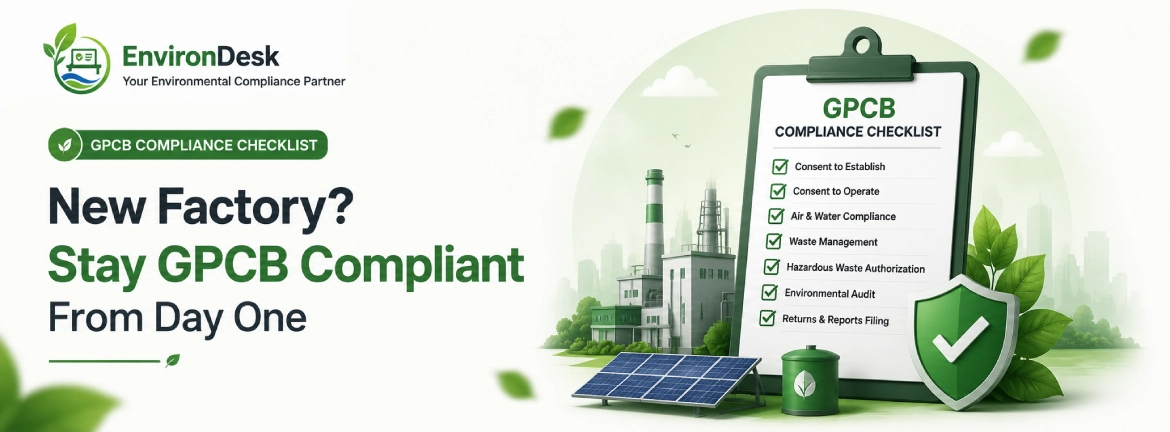
Every environmental clearance a new Gujarat factory needs, in order: CTE, EC, CTO, hazardous waste authorisation and the returns that follow.
Most environmental non-compliance in a new factory is not deliberate. It comes from doing the right things in the wrong order — pouring a foundation before the Consent to Establish is in hand, or commissioning a boiler that was never in the application.
This is the sequence, from land to running unit, for a factory in Gujarat. Follow it in order and the clearances stack. Jump ahead and you spend the year unwinding.
Step 0: Know your category before anything else
Every industrial activity in India is classified by CPCB into Red, Orange, Green or White, based on a Pollution Index score derived from emissions, effluent, hazardous waste and resource consumption. Your category determines almost everything downstream: whether you need consent at all, how long it lasts, what monitoring you owe, and where you are allowed to set up.
| Category | Consent needed | Typical validity | Siting |
|---|---|---|---|
| Red | CTE + CTO | Up to 5 years | Restricted; barred in some zones and near ecologically sensitive areas |
| Orange | CTE + CTO | Up to 10 years | Generally permitted in notified industrial areas |
| Green | CTE + CTO | Up to 15 years | Broadly permitted |
| White | Intimation only — no consent required | Not applicable | Broadly permitted |
Get this classification wrong and every subsequent document is wrong. If your unit sits near a category boundary — and plenty do, particularly in textile processing and food — settle it with GPCB in writing before you file anything.
Step 1: Site and land clearances
- Plot allotment letter or lease deed — GIDC allotment, or clear title for private land
- Non-agricultural (NA) permission where the land was previously agricultural
- Local body NOC — Gram Panchayat, Nagarpalika or Municipal Corporation
- Confirmation the plot's zoning permits your category
- Distance check against ecologically sensitive areas, water bodies and habitation
- For GIDC plots: confirmation of CETP connectivity and available inlet load
Step 2: Environmental Clearance — only if you need it
Environmental Clearance (EC) is a central approval under the EIA Notification, 2006, granted by MoEFCC or by the State Environment Impact Assessment Authority (SEIAA), depending on whether your project is Category A or Category B. It is not a GPCB consent, and it applies only to project types listed in the notification's schedule, above threshold.
Most small and medium units never need one. If your activity and capacity are listed, you need EC before CTE — it is a precondition, not a parallel track. The full process is covered in environmental clearance process in India.
Step 3: Consent to Establish (CTE)
CTE is GPCB's permission to build. It is granted under the Water Act and the Air Act and is filed on the XGN portal. Apply before construction — not before commissioning, before construction.
What CTE needs
- Project report with the manufacturing process and a flow diagram
- Plot documents — allotment letter or lease deed, and the site plan
- Detailed water balance: source, consumption by use, effluent generated
- Effluent treatment scheme with ETP design and unit sizing
- Air pollution control scheme — stack heights, APC equipment per source
- Hazardous waste streams with expected quantities per HOWM Rules, 2016 schedules
- Capital investment estimate certified by a chartered accountant
- EC letter, where EC applies
- Consent fee challan for the correct slab
The water balance is where CTE applications are won or lost. GPCB reads it closely, because it determines your effluent load, which determines your ETP sizing, which determines whether the scheme in front of them is credible. A water balance that doesn't balance is a query.
Step 4: Build to what you declared
This is the step with no form attached, and the one that causes the most grief. Your CTE approves a specific factory: specific capacity, specific equipment, specific treatment. If what gets built differs — a bigger boiler, an extra production line, a different ETP configuration — you do not have consent for what you built.
- Changed capacity or added a product → CTE amendment, before you commission it
- Changed the ETP scheme → amendment, with the revised design
- Added a stack or a DG set → amendment; DG sets have their own siting and stack-height requirements
- Nothing changed → keep the drawings, you will be asked for them at CTO inspection
If you are deciding between an ETP and an STP — or discovering you need both — our comparison explains which one your effluent actually calls for.
Step 5: Consent to Operate (CTO)
Once the unit is built and the pollution control equipment is installed and running, apply for CTO — permission to actually produce. GPCB will inspect. They are checking that the factory in front of them is the factory in the CTE.
- CTE copy and any amendments
- Photographs and commissioning evidence for the ETP/STP and APC equipment
- Trial-run analysis reports from a NABL-accredited lab
- Stack monitoring reports for each emission source
- Flow meter installation at the ETP inlet and outlet
- Hazardous waste storage area built to HOWM Rules specification
- TSDF membership or a co-processing tie-up for your waste streams
- CETP membership certificate, if applicable
- Display board with consent details, installed at the gate
CTO is the one you will live with. It carries your discharge limits and conditions, and it expires — renewal is its own discipline, covered in our CTO renewal guide.
Step 6: Hazardous waste authorisation
If your process generates any waste listed in the schedules to the Hazardous and Other Wastes (Management and Transboundary Movement) Rules, 2016, you need authorisation. ETP sludge alone puts a very large share of units in scope — including many that assume they are clean.
- Authorisation application listing each waste stream against its schedule entry
- Storage area: impervious flooring, secondary containment, roofing, signage
- Membership of a TSDF, or a documented co-processing arrangement
- Form 3 records and Form 10 manifests for every consignment moved
- Annual return in Form 4
Step 7: The recurring obligations
Clearances are the start. What follows is a calendar, and this is where units with perfect paperwork at commissioning quietly drift out of compliance in year two.
| Obligation | Frequency | Notes |
|---|---|---|
| Form-V environmental statement | Annual | Due 30 September for the financial year ending 31 March |
| Hazardous waste annual return (Form 4) | Annual | Typically due 30 June |
| ETP/STP outlet analysis | Monthly or as per consent | NABL lab; against your consent limits, not generic norms |
| Stack emission monitoring | As per consent | Every source listed in the order |
| Ambient air quality monitoring | As per consent | Usually applies to Red-category units |
| OCEMS data transmission | Continuous | For specified Red-category units, streamed to GPCB/CPCB servers |
| EC compliance report | Six-monthly | Only where EC applies |
| CTO renewal | Per category validity | Start 120 days before expiry |
The one-page version
- Confirm your CPCB category in writing.
- Secure the plot, zoning, NA permission and local body NOC.
- Obtain Environmental Clearance if your project is scheduled and above threshold.
- Apply for CTE on XGN before construction starts.
- Build exactly what the CTE approved — amend it if anything changes.
- Commission the ETP/STP and air pollution control equipment.
- Apply for CTO with trial-run data and host the inspection.
- Obtain hazardous waste authorisation and build the storage area properly.
- Put the recurring calendar in place on day one, not in year two.
Get the free GPCB compliance checklist
Every clearance a Gujarat factory needs, with document lists and renewal timelines. 12 pages, no charge.
Dr. Sneha Iyer
Head of Regulatory Research, EnvironDesk
Sneha holds a PhD in Environmental Engineering and previously advised industrial associations on CPCB and GPCB compliance. She tracks every notification so EnvironDesk customers don't have to.
General information, not legal advice. Environmental regulation changes, and how a rule applies depends on your unit's category, location and consent conditions. Verify anything decision-critical against the current GPCB or CPCB position, or take professional advice.
Related reading
All articles → Guide8 min read
Complete Guide to CTO Renewal in Gujarat (2026)
How to renew your Consent to Operate with GPCB: when to apply, every document you need, the XGN process step by step, fees, and what happens if your CTO lapses.
Read more Guide6 min read
Environmental Clearance Process in India: A Step-by-Step Guide
Do you need EC? Category A vs B, the four stages from screening to appraisal, PARIVESH filing, timelines, and the six-monthly compliance that follows.
Read more