
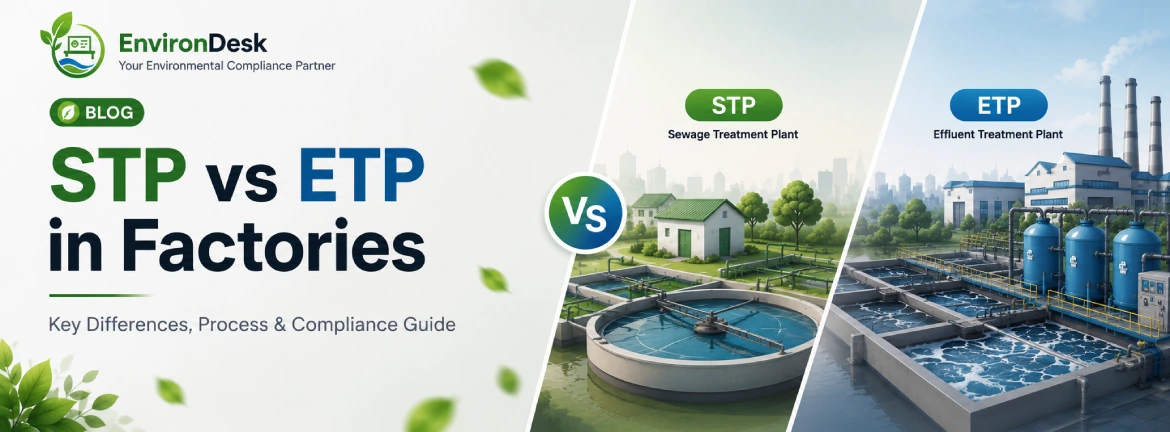
STP or ETP? The difference, which one GPCB expects, why most factories need both, and how to size them so they don't fail at full capacity.
The question comes up at the CTE stage, usually phrased as an either/or: do we need an STP or an ETP? For most factories the honest answer is *both*, because they treat two different waste streams that happen to arrive as the same word — water.
Here is what separates them, how GPCB looks at each, and how to work out what your unit actually needs.
The core difference
An STP (Sewage Treatment Plant) treats domestic sewage — toilets, washrooms, canteen, bathing. The contamination is organic and biological, and it is broadly the same everywhere on earth. Human waste from a pharma plant looks like human waste from a school.
An ETP (Effluent Treatment Plant) treats industrial effluent — whatever your process discharges. Its composition is specific to what you make: dye bath liquor, spent acid, oily condensate, solvent-bearing wash water. Two textile units on the same road can need materially different ETPs.
| STP | ETP | |
|---|---|---|
| Treats | Domestic sewage — toilets, canteen, washrooms | Process effluent from manufacturing |
| Contaminant type | Organic and biological; predictable | Chemical, and specific to your process |
| Design basis | Per-capita sewage generation × headcount | Water balance and effluent characterisation |
| Design varies by | Headcount, essentially | Product, process, chemistry, load variability |
| Typical load | BOD, COD, TSS, coliform | COD, TDS, heavy metals, colour, oil & grease, pH |
| Core process | Biological — MBBR, SBR, MBR | Physico-chemical + biological, often multi-stage |
| Sludge | Largely benign; often usable as manure | Frequently hazardous under the HOWM Rules |
| GPCB view | Expected of anyone with staff on site | The heart of your consent conditions |
Which does your factory need?
You need an STP if
You have people on site. That is close to the whole test. If your unit has toilets and a canteen, it generates sewage, and that sewage has to go somewhere legitimate — an STP, a sewer connection where the local body permits it, or a CETP that accepts a domestic stream.
Sizing is arithmetic: headcount × per-capita sewage generation, plus a peak factor. Design standards for domestic sewage generation are well established; the number your consultant applies should be defensible against the local body's own norms.
You need an ETP if
Your process discharges water that is not fit to leave as it is. In practice this covers most Red and Orange category units, and a surprising share of Green ones — a unit that only rinses components still discharges a rinse stream.
The exceptions are genuinely dry processes: assembly, packaging, certain engineering operations. If you believe you are one of them, get it confirmed in writing at the CTE stage, because 'we don't generate effluent' is a claim GPCB tests at inspection.
What an ETP actually contains
ETPs are staged, and each stage exists to make the next one possible. Skipping a stage to save capital reliably costs more in operating expense and consent trouble.
- 1
Preliminary — screening and equalisation
Removes solids and, critically, evens out the flow and load. Batch processes discharge in slugs; without equalisation, everything downstream sees a moving target and nothing works consistently.
- 2
Primary — physico-chemical
Neutralisation, coagulation, flocculation and settling. Takes out suspended solids, colour and much of the metals load. Where most of the chemical cost sits.
- 3
Secondary — biological
Aeration and clarification, where microorganisms consume the dissolved organic load. This is what pulls BOD and COD down to consentable levels. It is also alive, which means it dies if you shock it.
- 4
Tertiary — polishing
Filtration, activated carbon, sometimes RO. Needed where consent limits are tight, where you reuse the water, or where colour must go.
- 5
Sludge handling
Thickening, dewatering, and disposal. Almost always the stage that gets under-designed, and almost always where inspections find problems.
What if there's a CETP in the estate?
In GIDC estates with a Common Effluent Treatment Plant, member units discharge to the CETP rather than to the environment. This does not remove your ETP obligation — it changes it.
- You still need primary treatment. The CETP accepts effluent at a defined inlet quality. You treat to that inlet standard; the CETP does the rest.
- Inlet limits are contractual and statutory. Exceed them and you are a defaulting member as well as a violator.
- Estate capacity is finite. A CETP near its sanctioned load cannot take a new high-load discharger, whatever the plot broker says.
- The CETP's failures become yours. When an estate CETP is under a GPCB direction, member units feel it.
Sizing: the mistake that compounds
Under-sizing an ETP is the single most expensive decision a new unit makes, because it is invisible for about eighteen months. The plant works at commissioning, when you are running at 40% of capacity. It fails when you reach the capacity you actually built the factory for — at which point the consent limits are already in force, expansion means civil work, and every month of overshoot is on record in your own monitoring reports.
- Size against declared capacity, not current production.
- Characterise the effluent properly — a real analysis, not a textbook value for 'textile effluent'.
- Design for peak load and slug discharge, not the daily average.
- Leave headroom for the product you will add in year three.
- Budget the operating cost, honestly. An ETP that is too expensive to run gets switched off at night, which is how units end up with a direction.
There is no such thing as an ETP that is switched off. There is only an ETP that is switched off and a discharge that is unconsented.
The short version
- STP = sewage from your people. If you have staff, you need a route for it.
- ETP = effluent from your process. If your process touches water, you almost certainly need one.
- Most factories need both, kept separate.
- In a CETP estate, you still treat to the inlet standard.
- Size for declared capacity, characterise properly, and budget the running cost.
Once both are running, the compliance work is continuous: monthly analysis against your consent limits, sludge manifests, and the numbers that feed your Form-V annual statement. EnvironDesk checks every lab result against the limits in your own consent order and flags an exceedance the moment it is entered — see lab report management and EHS software built for India.
Get the free GPCB compliance checklist
Every clearance a Gujarat factory needs, with document lists and renewal timelines. 12 pages, no charge.
Dr. Sneha Iyer
Head of Regulatory Research, EnvironDesk
Sneha holds a PhD in Environmental Engineering and previously advised industrial associations on CPCB and GPCB compliance. She tracks every notification so EnvironDesk customers don't have to.
General information, not legal advice. Environmental regulation changes, and how a rule applies depends on your unit's category, location and consent conditions. Verify anything decision-critical against the current GPCB or CPCB position, or take professional advice.
Related reading
All articles → Checklist7 min read
GPCB Compliance Checklist for New Factories
Every environmental clearance a new Gujarat factory needs, in order: CTE, EC, CTO, hazardous waste authorisation and the returns that follow.
Read more Guide8 min read
Complete Guide to CTO Renewal in Gujarat (2026)
How to renew your Consent to Operate with GPCB: when to apply, every document you need, the XGN process step by step, fees, and what happens if your CTO lapses.
Read more