
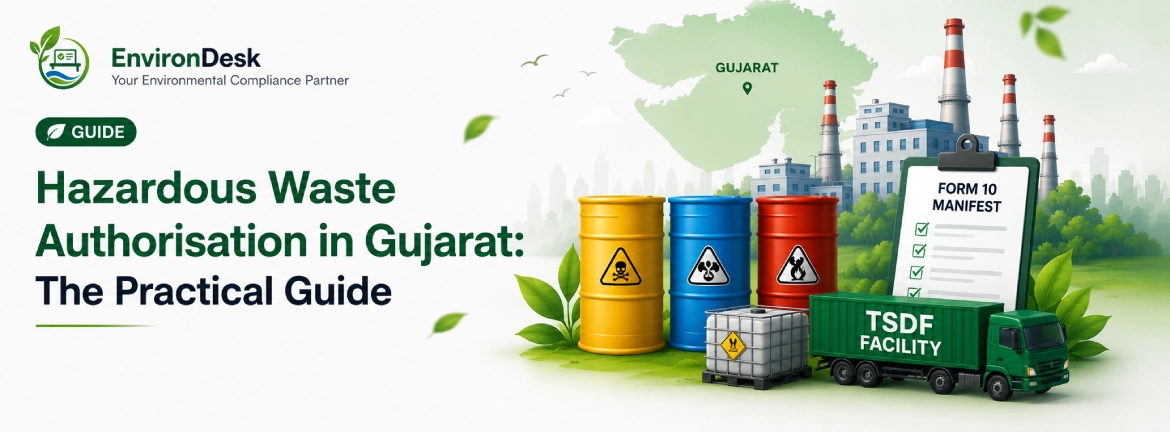
When your factory needs hazardous waste authorisation, how the HW Rules 2016 work, what Form 10 manifests are for, and how it ties into your CTO renewal.
If your unit generates hazardous waste — spent solvents, ETP sludge, used oil, contaminated packaging, process residues — you need an authorisation to handle it, and you need to move it only through legal channels. This is governed by the Hazardous and Other Wastes (Management and Transboundary Movement) Rules, 2016, and in Gujarat it is administered by GPCB alongside your consent.
The authorisation is not a side document. A lapsed or missing hazardous waste authorisation will hold your CTO renewal hostage, and an untracked waste stream is one of the fastest ways to attract a GPCB direction. Here is how it actually works.
Who needs authorisation
You need hazardous waste authorisation if you generate, collect, store, package, transport, use, treat, recycle, recover, dispose of or handle hazardous waste, as defined in the schedules to the 2016 Rules. In practice, almost every Red and many Orange category units qualify — the question is rarely *whether* your waste is hazardous, but *which schedule* it falls under.
The Rules classify waste through their schedules: some by the process that generates it, some by the constituents it contains. Getting the classification right matters, because it drives your storage conditions, your disposal route and the entries on every manifest you raise.
What the authorisation obliges you to do
An authorisation is a set of duties, not a certificate you file and forget. The core obligations of an occupier under the 2016 Rules:
- Store hazardous waste safely, in a designated area, for no longer than the permitted period
- Label and package waste as prescribed, with the correct hazard information
- Send waste only to an authorised recycler, co-processor or TSDF — never to the informal market
- Raise a Form 10 manifest for every consignment that leaves the premises
- Maintain records of waste generated, stored and disposed, and file the annual return (Form 4)
- Report accidents involving hazardous waste to GPCB
Form 10: the manifest system
Form 10 is the manifest — the document that follows a consignment of hazardous waste from your gate to its destination. It is the paper trail that proves your waste went where it was supposed to, and it is the first thing an inspector reconciles against your Form-V and your storage records.
The manifest is a multi-copy document shared between the sender (you), the transporter and the receiver (the TSDF, recycler or co-processor). Each party signs and retains a copy, so the chain is verifiable end to end. A gap in the manifest trail — waste that left but has no receiving signature — is exactly the kind of discrepancy that turns a routine inspection into a query.
Where the waste can legally go
The 2016 Rules push waste up a hierarchy — prevention and recovery before disposal. In practice, a Gujarat unit's waste leaves through one of these routes:
| Route | Typical waste | What you must verify |
|---|---|---|
| Authorised recycler | Used oil, spent solvents, metal-bearing waste | The recycler's registration covers your waste category |
| Co-processing (cement kilns) | High-calorific residues, certain sludges | Co-processor is authorised for the specific stream |
| TSDF (treatment, storage, disposal facility) | ETP sludge, non-recoverable residues | Active membership and the facility accepts the category |
| Approved actual user | Waste usable as raw material by another unit | The receiving unit is authorised to use it |
Applying and renewing on XGN
Like every GPCB clearance in Gujarat, hazardous waste authorisation is filed on XGN, against your existing unit profile. If the mechanics of the portal are new to you, our guide to the XGN portal covers registration, uploads and scrutiny in full.
- 1
File against your unit profile
Raise the authorisation on the same XGN profile that holds your consents. Most units file or renew it together with the CTO so the validity stays aligned.
- 2
Declare every waste stream
List each hazardous waste with its schedule classification, the quantity generated, how it is stored and its disposal route. Undeclared streams are the ones that cause trouble later.
- 3
Attach the disposal-tie-up proof
TSDF membership, recycler or co-processor agreements — the documents that show each declared stream has an authorised destination.
- 4
Renew before it expires
Track the authorisation's validity like any other consent date. An expired authorisation with waste still being generated is an active liability, not a paperwork lapse.
What non-compliance costs
Handling hazardous waste without authorisation, or disposing of it outside the legal channels, is an offence under the Environment (Protection) Act, 1986, through which the 2016 Rules are made. GPCB can issue directions, and in serious cases the escalation runs the same way as any consent breach — show-cause, direction, and closure enforced through the electricity supply. We traced that full escalation ladder in what happens if your factory doesn't have GPCB NOC.
The waste that gets a unit into trouble is almost never the waste it declared. It is the stream nobody classified, stored in a corner, moving out through a transporter nobody checked.
The short version
Classify every waste stream against the 2016 Rules. Store it properly, move it only to authorised recyclers, co-processors or a TSDF, and raise a Form 10 manifest for every consignment. Keep your generated, moved and declared quantities reconciled across your records, your manifests and Form-V. File the authorisation on XGN against your unit profile, and renew it in step with your CTO.
Above all, treat the authorisation's expiry as a tracked deadline with an owner — not a date buried in the consent order that someone is supposed to remember.
Get the free GPCB compliance checklist
Every clearance a Gujarat factory needs, with document lists and renewal timelines. 12 pages, no charge.
Dr. Sneha Iyer
Head of Regulatory Research, EnvironDesk
Sneha holds a PhD in Environmental Engineering and previously advised industrial associations on CPCB and GPCB compliance. She tracks every notification so EnvironDesk customers don't have to.
General information, not legal advice. Environmental regulation changes, and how a rule applies depends on your unit's category, location and consent conditions. Verify anything decision-critical against the current GPCB or CPCB position, or take professional advice.
Related reading
All articles → Guide8 min read
Complete Guide to CTO Renewal in Gujarat (2026)
How to renew your Consent to Operate with GPCB: when to apply, every document you need, the XGN process step by step, fees, and what happens if your CTO lapses.
Read more Guide6 min read
The XGN Portal, Explained: Registration, Login and Filing
XGN is where every GPCB consent, authorisation and return in Gujarat is filed. How to register a unit, log in, raise CTE and CTO applications, clear queries.
Read more