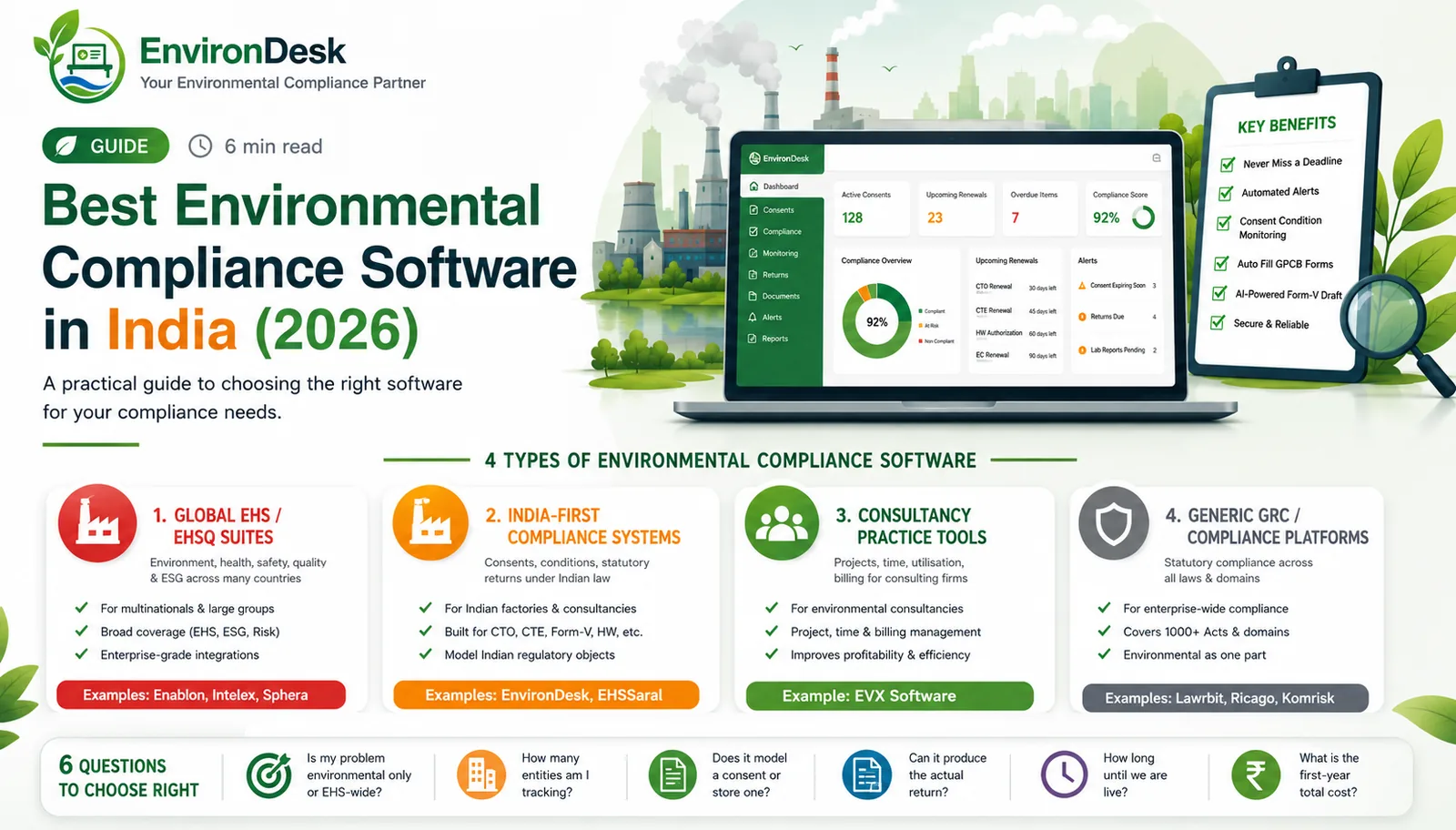
An honest guide to the environmental compliance software available to Indian factories, consultancies and audit firms in 2026 — and how to choose.
"Environmental compliance software" covers at least four different products in India, and most of the frustration buyers feel comes from comparing tools that were never meant to solve the same problem. A global EHS suite, an India-first compliance system, a consultancy project-management platform and a generic GRC tool will all answer your enquiry. Only one of them is likely to fit.
This guide sorts them by the job they actually do, then gives a short, honest read on the notable options in each group.
First, work out which category you need
| Category | What it is built to do | Right for you if |
|---|---|---|
| Global EHS / EHSQ suites | Environment, health, safety, quality and often ESG across many countries | You are a multinational or large group needing one system everywhere |
| India-first compliance systems | Consents, conditions, statutory returns and monitoring under Indian law | Your obligations are CTO, CTE, Form-V, hazardous waste authorisation |
| Consultancy practice / project tools | Projects, time, utilisation, billing for consulting firms | Your problem is project profitability, not a missed renewal |
| Generic GRC / compliance platforms | Statutory compliance across all laws — labour, tax, corporate, environmental | You need enterprise-wide legal compliance, environmental as one slice |
India-first compliance systems
These model Indian regulatory objects natively — the CPCB category, the consent order and its numbered conditions, the statutory returns. That is what makes automatic compliance scoring and form generation possible at all. The trade-off is narrower scope: they generally do not cover occupational safety or global ESG reporting.
EnvironDesk
Built in Ahmedabad for Indian environmental consultancies, factory EHS teams and audit firms. Tracks CTO, CTE and EC deadlines with a 90/60/30/7-day alert ladder over WhatsApp and email, stores consent conditions as testable numeric limits, scores NABL lab results against them automatically, auto-fills GPCB forms including CTE, CTO, Form-V and Form-IV from one factory profile, and drafts Form-V with AI. Multi-client by design, so a consultancy managing 50–200 factories works from one calendar. Data hosted in AWS Mumbai. Priced per practice on active factories and team logins; 14-day free trial.
- Strongest at: GPCB and Gujarat depth, consent-condition modelling, statutory returns, multi-client consultancy structure.
- Weakest at: occupational health and safety modules, global ESG reporting, and state-specific form preparation outside Gujarat — tracking works with any SPCB, deep form support does not yet.
- Right for: Indian consultancies, audit firms and factory EHS teams whose main risk is a lapsed consent.
EHSSaral
Another India-focused entrant, positioned around Indian EHS officers and SPCB/CPCB obligations rather than adapted foreign software, and backed by long-standing environmental consulting experience. Publishes a substantial library of Indian regulatory explainers. Worth shortlisting alongside us if you want an India-first system — genuinely the closest comparison in positioning.
- Strongest at: India-specific framing, deep regulatory content library.
- Right for: Indian SMEs and EHS officers wanting an India-first system; compare feature-by-feature against your actual form set.
Global EHS and EHSQ suites
Mature, broad and expensive. They cover far more ground than any India-first tool, and they are the correct answer for large multinationals. The recurring difficulty for Indian buyers is that a consent order is represented as a generic permit — so the configuration work needed to make CPCB categories and Indian returns behave properly falls on your team, and someone has to maintain it when the rules change.
Enablon (Wolters Kluwer)
Enterprise EHS, operational risk and ESG in one platform, used by Fortune 500 and Global 2000 operators across roughly 160 countries, with named customers including Boeing and BNP Paribas. Skews to asset-intensive industries — energy, oil and gas, chemicals, manufacturing. Deep enterprise integration including Microsoft Azure, and a mobile app for field reporting. Enterprise pricing, not published.
- Right for: multinationals needing unified EHS, risk and ESG across many countries.
- Not right for: a 12-person Gujarat consultancy — the implementation alone will outweigh the problem.
- Read more: EnvironDesk vs Enablon.
Intelex
A broad EHSQ platform covering environment, health, safety and quality — incident and injury management, audits, inspections, document control, permits, waste and sustainability reporting. Part of Industrial Scientific since 2019, which brought investment in mobile and connected-worker capability. One of the few in this bracket to publish entry-level pricing, though the entry plan covers core safety rather than the environmental modules an Indian factory needs.
- Right for: companies wanting safety, quality and environment in one system.
- Not right for: firms whose whole problem is Indian statutory environmental filing.
- Read more: EnvironDesk vs Intelex.
Others in this bracket worth a look if you are running an enterprise process: Cority, Sphera, VelocityEHS and Locus Technologies. All are competent; all share the same India-specific caveat.
Consultancy practice and project tools
EVX Software
Purpose-built business and project management for environmental consulting and engineering firms — projects, tasks, time tracking, expenses, billing, invoicing and business intelligence, with integrations to Microsoft 365, Google Workspace, QuickBooks and Sage. It is aimed squarely at the commercial half of running a consultancy, which is a real and under-served problem.
- Right for: firms losing margin on unbilled time and unclear project profitability.
- Not right for: firms whose risk is a missed statutory deadline — it is not a regulatory compliance system and does not claim to be.
- Read more: EnvironDesk vs EVX Software.
Generic GRC and compliance platforms
Indian GRC platforms such as Lawrbit, Ricago and Komrisk cover statutory compliance across the whole legal estate — labour, tax, corporate secretarial, environmental — typically spanning thousands of Acts and tens of thousands of compliance items. If your mandate is enterprise-wide legal compliance and environmental is one of fifteen domains you track, these are a sensible fit.
They are a poor fit if environmental compliance *is* the job. Breadth across 2,000 Acts necessarily means shallow treatment of any one: you will get a task saying "renew Consent to Operate" and a place to upload the order, but not the consent conditions as testable limits, not lab-result scoring, and not a drafted Form-V.
How to choose, in six questions
- Is my problem environmental only, or EHS-wide? If you need incident management and safety training, look at the global suites. If it is consents and returns, look India-first.
- How many entities am I tracking? One site is a different product from 150 client factories. Ask specifically whether the tool is multi-client or multi-site — they are not the same.
- Does it model a consent, or store one? Ask for the demo described above. This single question separates the categories faster than a feature matrix.
- Can it produce the actual return? Not "a report" — Form-V, with its nine parts, from your own data.
- How long until we are live? Same-day from a spreadsheet, or a six-month implementation? The most common failure in this category is software that is bought, configured for months and never adopted while the team quietly keeps the spreadsheet.
- What is the first-year total? Compare implementation, training and support, not headline licence cost. Enterprise implementations frequently exceed the licence.
The short version
If you are a multinational, buy a global EHS suite and accept the India configuration work. If your problem is project profitability, buy a consultancy practice tool. If you need enterprise-wide legal compliance across every Act, buy a GRC platform. And if your actual risk is that a Consent to Operate lapses on a date nobody was watching, buy something that knows what a Consent to Operate is.
Get the free GPCB compliance checklist
Every clearance a Gujarat factory needs, with document lists and renewal timelines. 12 pages, no charge.
Vishal Mevada
Co-founder, EnvironDesk
Vishal spent nine years running environmental compliance for factory clients across Gujarat's GIDC estates before starting EnvironDesk. He has filed more CTO renewals than he cares to count.
General information, not legal advice. Environmental regulation changes, and how a rule applies depends on your unit's category, location and consent conditions. Verify anything decision-critical against the current GPCB or CPCB position, or take professional advice.
Related reading
All articles →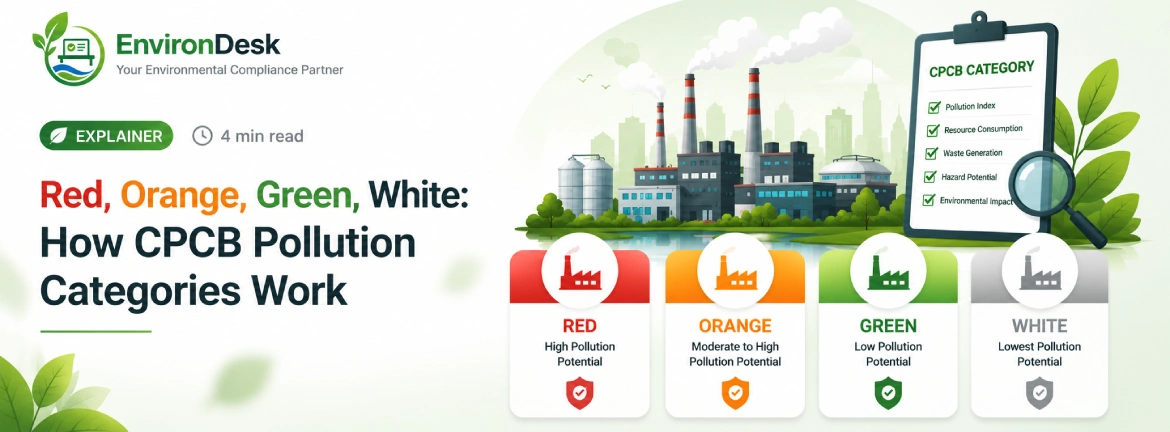 Explainer4 min read
Red, Orange, Green, White: How CPCB Pollution Categories Work
What CPCB Red, Orange, Green and White categories mean, how the pollution index decides yours, and why your category drives consent validity and fees.
Read more Guide8 min read
Complete Guide to CTO Renewal in Gujarat (2026)
How to renew your Consent to Operate with GPCB: when to apply, every document you need, the XGN process step by step, fees, and what happens if your CTO lapses.
Read more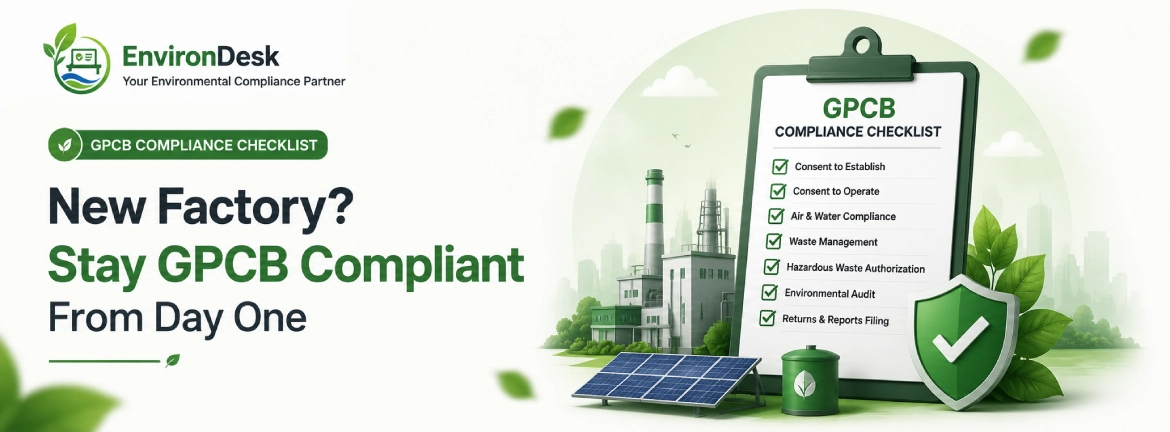 Checklist7 min read
GPCB Compliance Checklist for New Factories
Every environmental clearance a new Gujarat factory needs, in order: CTE, EC, CTO, hazardous waste authorisation and the returns that follow.
Read more