
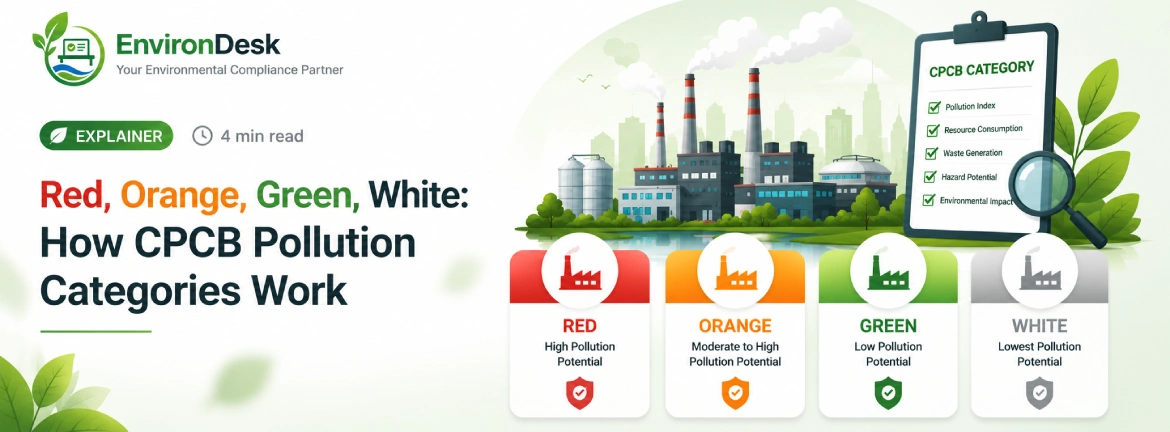
What CPCB Red, Orange, Green and White categories mean, how the pollution index decides yours, and why your category drives consent validity and fees.
Almost every compliance question a factory asks GPCB starts with one answer it may not have thought about: what category is my unit? Red, Orange, Green or White is not a label — it is the setting that quietly decides how long your consent lasts, how much you pay, how often you are inspected and, in some areas, whether you can set up at all.
This explainer covers where the categories come from, how the pollution index assigns them, and the compliance consequences that follow from the colour your unit ends up with.
Where the categories come from
The Central Pollution Control Board (CPCB) reclassified industrial sectors in 2016 using a single, transparent number: the Pollution Index (PI). The PI scores a sector from 0 to 100 on the emissions, effluent, hazardous waste and resource consumption it typically involves. The higher the score, the more polluting the sector, and the redder the category.
The point of the reform was to replace a patchy, state-by-state system with one national logic — and to create the White category, which lets genuinely non-polluting units out from under consent requirements entirely.
The four categories, by pollution index
| Category | Pollution Index | Character |
|---|---|---|
| Red | 60 and above | Most polluting — heavy emissions, effluent or hazardous waste |
| Orange | 41 to 59 | Moderately polluting |
| Green | 21 to 40 | Low-polluting |
| White | Up to 20 | Practically non-polluting |
The colour is assigned to the sector, not judged unit by unit — CPCB publishes the list of which industries sit in which category, and GPCB applies it. Your job is usually to identify your sector correctly on that list, not to argue the score.
Red category
PI of 60 or above. This is where the heavily regulated sectors sit — dyes and dye intermediates, pesticides, bulk drugs, tanneries, distilleries, cement, and similar. Red units carry the shortest consent validity, the fullest monitoring obligations, and the closest inspection attention. Many are also subject to siting restrictions in critically polluted areas.
Orange category
PI between 41 and 59. Textile processing, food and agro-processing, foundries and many chemical formulation units land here. Substantial compliance obligations, but longer consent validity and a lighter monitoring load than Red.
Green category
PI between 21 and 40. Assembly, packaging, light engineering and similar low-impact activities. Consents are longer-lived and the compliance load is proportionate to the modest pollution potential.
White category
PI up to 20 — practically non-polluting. This is the category that changed the picture in 2016. White units do not require consent to operate; in most states they need only file an intimation to the board. No CTO renewal cycle, no consent fee. It is worth checking carefully whether your activity genuinely qualifies, because the relief is significant.
Why your category drives everything else
The category is upstream of most of your compliance calendar. Change the colour and you change the numbers:
| Lever | Redder category means | Greener category means |
|---|---|---|
| Consent validity | Shorter — renew more often | Longer — up to 15 years for Green |
| Monitoring | More frequent effluent, stack and ambient testing | Lighter monitoring load |
| Inspection | Closer and more frequent GPCB attention | Proportionately less |
| Siting | Possible restrictions in polluted areas | Fewer locational constraints |
How to find your category
- 1
Identify your primary activity
Categorisation follows the industrial activity, not the company name. A unit doing more than one activity takes the category of its most polluting one.
- 2
Match it to the CPCB list
Find your sector on CPCB's published categorisation. Sectors are named specifically — do not guess by analogy from a similar-sounding one.
- 3
Confirm against your consent order
Your existing GPCB consent states your category. If a new activity or expansion has changed your effective category, that is a disclosure to make on your next application, not something to carry over silently.
The short version
CPCB scores industrial sectors on a 0–100 pollution index and colours them Red (60+), Orange (41–59), Green (21–40) or White (up to 20). The colour is assigned to your sector, and it sets your consent validity, your monitoring frequency, your inspection exposure and, for White units, whether you need consent at all.
Identify your category correctly, confirm it against your consent order, and disclose any activity that would change it. Everything downstream — the renewal cadence, the testing schedule, the deadlines you have to track — flows from that one setting.
Get the free GPCB compliance checklist
Every clearance a Gujarat factory needs, with document lists and renewal timelines. 12 pages, no charge.
Dr. Sneha Iyer
Head of Regulatory Research, EnvironDesk
Sneha holds a PhD in Environmental Engineering and previously advised industrial associations on CPCB and GPCB compliance. She tracks every notification so EnvironDesk customers don't have to.
General information, not legal advice. Environmental regulation changes, and how a rule applies depends on your unit's category, location and consent conditions. Verify anything decision-critical against the current GPCB or CPCB position, or take professional advice.
Related reading
All articles → Guide8 min read
Complete Guide to CTO Renewal in Gujarat (2026)
How to renew your Consent to Operate with GPCB: when to apply, every document you need, the XGN process step by step, fees, and what happens if your CTO lapses.
Read more Checklist7 min read
GPCB Compliance Checklist for New Factories
Every environmental clearance a new Gujarat factory needs, in order: CTE, EC, CTO, hazardous waste authorisation and the returns that follow.
Read more